Vulnerable countries seek $1.3 trillion to cope with climate crisis
This article was written by the Associated Press and was published in the Toronto Star on November 21, 2024.
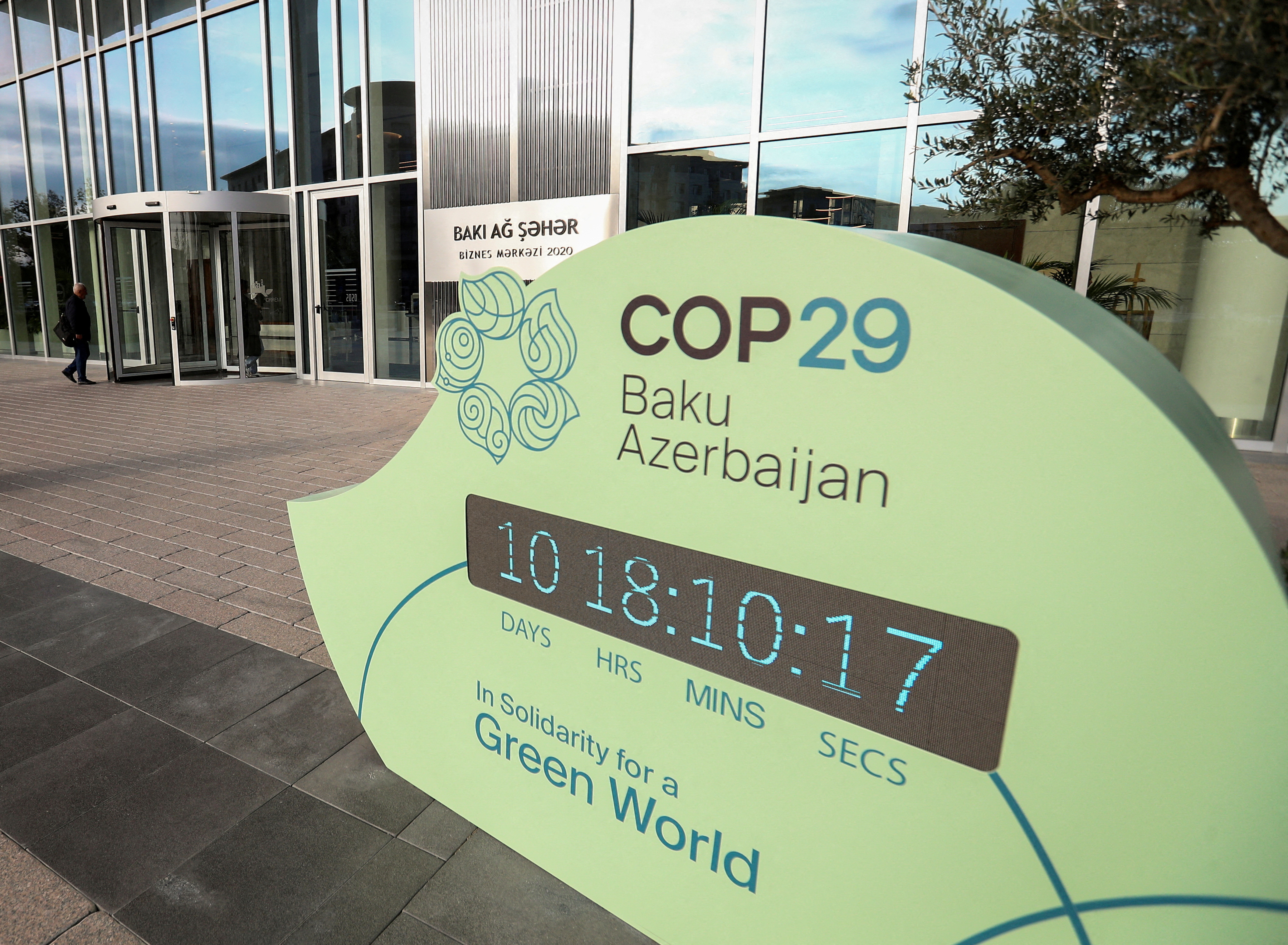
Activists call for progress on a climate financing deal Wednesday at the COP29 United Nations Climate Summit in Baku, Azerbaijan.
With time running down, negotiators at the United Nations annual climate talks on Wednesday remained mired in the maze of a trilliondollar money problem, turning to host Azerbaijan to lead the way to daylight with a promised map to be released in the dark of night.
Vulnerable nations are seeking $1.3 trillion (U.S.) to deal with damage from climate change and to adapt to that change, including building out their own cleanenergy systems. Experts agree that at least $1 trillion is called for, but both figures are far more than the developed world has so far offered.
Negotiators are fighting over three big parts of the issue: How big the numbers are, how much is grants or loans, and who contributes.
After 10 days of talks, the host presidency of the talks promised a draft proposal around midnight, which they acknowledged will be far from final and have many decisions still to be made. But it’s something, a clear step forward, said lead negotiator Yelchin Rafiyev.
German special climate envoy Jennifer Morgan late Wednesday afternoon put the onus on the COP29 presidency.
“Much is really now in the presidency’s hands and the options that they will put in front of us, the text that will come out,” Morgan said. “I think the options can help shift us into the fast lane towards a green and prosperous future or mire us in a fight about lowest common denominators.”
And the key to a solution is one word, Morgan said: Trust.
“The most critical currency right now is trust — trust in the presidency and trust between and among parties,” Morgan said.
This article was written by Seth Borenstein and Sibi Arasu, and was published in the Globe & Mail on November 16, 2024.
Good or bad, the United Nations climate negotiations process itself became the focus of the international talks that aim to curb warming from coal, oil and natural gas.
Environmental advocates released reports Friday decrying fossil fuel industry influence at the climate talks called COP29. At the same time, a letter signed by a former United Nations secretary general and ex-top climate negotiators called for dramatic reform. And the conference’s chief negotiator said current talks – aimed at striking a deal worth hundreds of billions of dollars to help finance a transition to clean energy and adapting to climate change – were going too slowly.
All that put the focus on process – not results.
“We consider COP29 as a litmus test for the global climate architecture,” conference lead negotiator Yalchin Rafiyev said at a Friday news conference.
A letter causes a stir about the direction of future talks
A letter signed by former UN chief Ban Ki-Moon, former UN climate secretary Christiana Figueres and former Ireland President Mary Robinson called for “a fundamental overhaul of the COP.”
“We need a shift from negotiation to implementation,” it said.
Two signees – Ms. Figueres and Johan Rockstrom, director of the Potsdam Institute for Climate Impact Research – said the letter was being badly misinterpreted as criticism of the climate talks. They said the letter was intended to show support for the process, which they said has worked and just needs to shift into a new mode.
Instead of spending so much effort negotiating new deals in annual conferences that can attract 70,000 people, the process should be smaller and more frequent and aimed at putting what was already agreed upon into action, Mr. Rockstrom said.
“It’s about strengthening the COP,” Mr. Rockstrom said. “It’s about recognizing we’ve accomplished so much that we have what we need. … We really need to get serious about delivery.”
Climate Analytics CEO Bill Hare said he had issues with some of the suggestions in the letter and personally considers the COP process broken. His analysis this week showed that after the 2015 Paris agreement projected future warming dropped, but in the past three years, warming projections – based on negotiations, promises and policies – for the future have stayed the same or even gone up slightly.
An analysis from the Kick Big Polluters Out coalition said Friday that the official attendance list of the talks featured at least 1,770 people connected to fossil fuel interests.
Catherine Abreu, director of the International Climate Politics Hub, suggested that there should be a “firewall” between fossil fuel lobbyists, UN climate bodies and negotiators from countries. “We know over 1,700 fossil fuel lobbyists are here at COP29. That is not acceptable,” she said.
Former U.S. Vice-President Al Gore, who on Friday presented new data on carbon pollution sites, said “it’s unfortunate that the fossil fuel industry and the petrostates have seized control of the COP process to an unhealthy degree.”
For his part, COP29 negotiator Mr. Rafiyev defended the process.
“The process has already delivered, the COP process so far by reducing projected warming, delivering finance to those in need,” Mr. Rafiyev said. “It’s better than any alternative.”
One key benefit of the UN climate talks process is it’s the only place where vulnerable small island nations have an equal seat at the table, United Nations Environment Programme Executive Director Inger Andersen told the Associated Press. But the process has its limits because “the rules of the game are set by member states,” she said.
At a press conference, Alliance of Small Islands States Chair Cedric Schuster said the negotiating bloc felt the need to remind everyone else why the talks matter.
“We’re here to defend the Paris agreement,” Mr. Schuster said, referring to the climate deal in 2015 to limit warming to 1.5 degrees Celsius above pre-industrial times. “We’re concerned that countries are forgetting that protecting the world’s most vulnerable is at the core of this framework.”
New data reveals the most polluting cities
Also at the talks Friday, new data from an organization cofounded by Mr. Gore that combines observations and artificial intelligence found that cities in Asia and the United States emit the most heat-trapping gas, with Shanghai the most polluting.
Using observations and artificial intelligence, Climate Trace quantifies heat-trapping carbon dioxide, methane and nitrous oxide, as well as other traditional air pollutants worldwide, including for the first time in more than 9,000 urban areas.
Seven states or provinces spew more than 1 billion metric tons of greenhouse gases, all of them in China, except Texas, which ranks sixth.
Earth’s total carbon dioxide and methane pollution grew 0.7 per cent to 61.2 billion metric tons with the short-lived but extra potent methane rising 0.2 per cent. The figures are higher than other datasets “because we have such comprehensive coverage and we have observed more emissions in more sectors than are typically available,” said Gavin McCormick, Climate Trace’s co-founder.
Shanghai’s 256 million metric tons of greenhouse gases led all cities and exceeded those from the nations of Colombia or Norway. Tokyo’s 250 million metric tons would rank in the top 40 of nations if it were a country, while New York’s 160 million metric tons and Houston’s 150 million metric tons would be in the top 50 of countrywide emissions. Seoul, South Korea, ranks fifth among cities at 142 million metric tons.
“One of the sites in the Permian Basin in Texas is by far the No. 1 worst polluting site in the entire world,” Mr. Gore said. “And maybe I shouldn’t have been surprised by that, but I think of how dirty some of these sites are in Russia and China and so forth. But Permian Basin is putting them all in the shade.”
China, India, Iran, Indonesia and Russia had the biggest increases in emissions from 2022 to 2023, while Venezuela, Japan, Germany, Britain and the United States had the biggest decreases in pollution.
The dataset – maintained by scientists and analysts from various groups – also looked at traditional pollutants such as carbon monoxide, volatile organic compounds, ammonia, sulfur dioxide and other chemicals associated with dirty air. Burning fossil fuels releases both types of pollution, Mr. Gore said.
This “represents the single biggest health threat facing humanity,” Mr. Gore said.
Leader after leader recount firsthand experience with climate change at annual UN conference
This article was written by Melina Walling, Sibi Arasu, and Seth Borenstein, and was published in the Toronto Star on November 14, 2024.
More than two dozen world leaders delivered remarks at the United Nations’ annual climate conference Wednesday, with many hardhit nations detailing their nations’ firsthand experience with the catastrophic weather that has come with climate change.
Leader after leader recounted climate disasters, with each one seeming to top the other. Grenada’s Prime Minister Dickon Mitchell detailed a 15month drought at the beginning of the year giving way to a Category 5 Hurricane Beryl.
“At this very moment, as I stand here yet again, my island has been devastated by flash flooding, landslides and the deluge of excessive rainfall, all in the space of a matter of a couple hours,” Mitchell said. “It may be small island developing states today. It will be Spain tomorrow. It will be Florida the day after. It’s one planet.”
Grenada’s premier wasn’t the only small island nation leader who came with fighting words.
Prime Minister of the Bahamas Philip Edward Davis warned that “it will be our children and grandchildren who bear the burden, their dreams reduced to memories of what could have been.”
“We do not — cannot — accept that our survival is merely an option,” Davis said.
Gaston Browne, the prime minister of Antigua and Barbuda, highlighted the “inverted morality” of big emitters who aren’t taking responsibility for their impacts on countries who have the most to lose. He said high polluting nations are “deliberately burning the planet.”
Past promises of financial aid went unfulfilled for too long, so small island nations will have to seek justice and compensation in international courts, Browne said.
Marshall Islands President Hilda Heine called the climate crisis “the most pressing security threat” her country faces, but said she thinks the Paris Agreement process — where countries agreed to limit warming to 1.5 C since preindustrial times — is resilient.
Azerbaijan President Ilham Aliyev took the opportunity to align his country with the predicament of small island developing states in a speech where he called out developed countries, in particular France and the Netherlands, for their colonial histories. He described the harms of colonialism that continue today. Biodiversity loss, rising seas and extreme weather hit communities that are often “ruthlessly suppressed,” he said.
The United States also tried to show sympathy to hardhit places.
“Do we secure prosperity for our countries or do we condemn our most vulnerable to unimaginable climate disasters?” United States chief climate envoy John Podesta said. “Vulnerable communities do not just need ambition. They need action.”
European nations also warned of climate catastrophe on their continent.
“Over the past year, catastrophic floods in Spain, Bosnia and Herzegovina as well as in southern Croatia have shown the devastating impact of rising temperatures,” said Croatia’s prime minister, Andrej Plenkovic. “The Mediterranean, one of the most vulnerable regions, calls for urgent action.”
Albania Prime Minister Edi Rama said he was dismayed by the lack of political action and political will and leaders of many nations not showing up at climate talks as extreme weather strikes harder and more frequently.
Frustrated with other leaders mere talk, Rama decried that “life goes on with old habits” and all these speeches filled with good intent change nothing.
Negotiators at the summit are looking to hammer out a deal on how much money, and in what form, developed countries will pledge for adapting to climate change and transitioning to clean energy for developing nations. On Wednesday morning, an early draft of what that final deal will look like was released, but it still contained multiple options that negotiators will wrestle over to reach a consensus by the end of the climate talks.
Canada also commits $160M for new fund to help lowincome countries at UN climate summit
This article was written by Alex Ballingall and was published in the Toronto Star on November 13, 2024.
Environment Minister Steven Guilbeault says the federal government is “very supportive” of talks to create a new levy on greenhouse gas emissions from maritime transportation, as countries gather in Azerbaijan to discuss ways to raise billions of dollars for climate action in cashstrapped developing nations.
Speaking to reporters by phone from Baku, where this year’s annual United Nations climate talks (COP29) are taking place, Guilbeault called for private sector banks and other financial institutions to help close what the Canadian government believes is a yawning, $2trillion (U.S.) shortfall in annual funding for developing countries to help prevent the worst extremes of climate change under the 2015 Paris Agreement.
To help rally more funding, Guilbeault said Canada is putting up $160 million to launch a new fund — called GAIA — that will finance projects to slash emissions and help lowerincome countries adapt to the damages of climate change, including small island states in the Caribbean. The fund will include direct grants and longterm loans, with a goal of rallying $2 billion from governments and private sources, Guilbeault said.
With contributions from Canada, the international Green Climate Fund and Japanese bank Mitsubishi Financial Group, Guilbeault said the fund already has more than $800 million committed to it, and that it will be “operational in the very near future.”
With climate financing expected to be a major focus at the Baku talks, Guilbeault acknowledged that there are a range of ideas to raise more money. Earlier this year, several countries — including France, Brazil and Germany — called for a global twopercent wealth tax on billionaires to raise money for climate action and poverty reduction.
Others, such as the International Monetary Fund, have called for global taxes on aviation and shipping emissions that an October report from the organization said could raise up to $200 billion (U.S.) per year by 2035.
Asked about those proposals Tuesday, Guilbeault said Canada has been “very engaged” in discussions on new ways to raise climate funds, and cited the federal government’s support for talks at the UN’s marine branch, which is looking at creating a carbon pricing mechanism to curb shipping emissions — something that some smallisland Pacific states have demanded in recent weeks.
“We are very supportive of the discussions that are happening at the International Marine Organization to put in place some kind of levy on international marine transportation,” Guilbeault said.
Miako Ushio, director of environmental affairs at the Shipping Federation of Canada, said her organization supports the idea of a global carbon price for the sector, but that it hasn’t taken a position on what should happen with any revenues generated.
Guilbeault, meanwhile, said he doubts such a policy will be agreed upon during this month’s UN climate talks, and that he expects an overall climate financing goal to be hammered out instead.
“The agreement we have to reach here is not necessarily exactly about which mechanism will enable us to achieve the funding goal that we will set for ourselves,” he said. “We need to agree on what the new amount will be.”
Activists like those from Climate Action Network Canada, an umbrella organization of more than 150 groups, want the federal government in Ottawa to triple Canada’s current climate finance pledge to $15.9 billion between 2026 and 2031.
Environment Minister Steven Guilbeault said Canada has been `very engaged’ in discussions on new ways to raise climate funds
This article was written by Victor Swezey and was published in the Globe & Mail on November 11, 2024.
Azerbaijan, the host country for COP29, has made significant investments in renewable energy, but it also shows no signs of weaning itself off of oil and gas, which long-serving President Ilham Aliyev recently called a ‘gift from God.’
For the second year in a row, diplomats and heads of state from around the world will meet in an oil-rich country to discuss the future of the climate.
The UN’s annual Conference of Parties will kick off on Nov. 11 in Azerbaijan – a small country between Russia and Iran on the Caspian Sea – focusing on climate finance.
Optimism is in short supply as the world’s largest economies have shown little appetite to increase their financial contributions to support green transitions for developing countries and to mitigate the effects of climate change for those most vulnerable.
In addition, the host country is under fire for human-rights abuses, alleged energy profiteering and a lack of commitment to moving away from fossil fuels.
“It’s going to be quite a difficult COP,” said Richard Kinley, who served as deputy secretary of the body overseeing the conference from 1992 to 2017.
The biggest challenge has come from the United States, where climate-change-denying former president Donald Trump sailed to victory in the election on Tuesday. Mr. Trump said on the campaign trail that he would expand fossil-fuel drilling and again pull the U.S. out of the 2015 Paris climate agreement, which seeks to cap global warming at 1.5 degrees Celsius.
He withdrew the U.S. from the accord during his first term as president.
Both Mr. Trump and outgoing President Joe Biden are sitting out this year’s summit, which is likely to be significantly smaller than COP28 in Dubai. The leaders of many of the world’s largest economies and biggest polluters will also be absent, including President Xi Jinping of China, Prime Minister Narendra Modi of India, and European Commission President Ursula von der Leyen.
The Canadian delegation, led by Environment Minister Steven Guilbeault, is going into the COP29 talks with two top objectives. One is to push for a new deal worth hundreds of billions of dollars to support developing countries with climate-change adaptation and mitigation projects. In 2009, rich countries agreed to provide US$100-billion annually in climate finance by 2020, with Canada committing US$5.3-billion. The target was achieved two years late, and now the needs have grown.
At the talks, Canada and allied donors will seek to scale up the contributions and call on other high-emitting countries to join in the climate finance effort, known as the New Collective Quantified Goal, or NCQG. They will also push for more policy tools and private-sector contributions to help increase funds for this effort.
Canada’s second main objective is to press countries to toughen their emissions-reduction targets when new goals are set in 2025, despite doubts about its own ability to do so.
This year is set to be the hottest on record and global natural disasters continue to intensify. With COP approaching the end of its third decade and emissions still rising, many experts are questioning whether the summits are the most effective method for combatting climate change.
“The definition of insanity is doing the same thing over and over again and expecting new results,” said Jessica Green, who researches climate governance at the University of Toronto. “We’re not getting new results.”
Host country Azerbaijan, which relies on fossil fuels for more than 90 per cent of its exports, is doing little to inspire confidence in this year’s conference.
Long-serving President Ilham Aliyev, whose father seized control of the small Caucasian country after the fall of the Soviet Union, has drawn international condemnation for banning opposition parties and imprisoning journalists.
Amnesty International published a report last month accusing the country of intensifying its crackdown on civil society ahead of the conference and calling on participating states to respond with diplomatic pressure.
While Azerbaijan has made significant investments in renewable energy, it also shows no signs of weaning itself off of oil and gas, which Mr. Aliyev recently called a “gift from God.”
Instead, the country is using the conference to secure new fossil-fuel investments. The chief executive of COP29, who also serves as Azerbaijan’s deputy energy minister, was caught using his position to promote deals with the country’s state-run oil and gas company in an investigation first reported by the BBC.
For some, doubts about COP have reached a breaking point.
Prime Minister James Marape of the Pacific island country of Papua New Guinea announced in August that he would not be participating. His Foreign Minister later called the event a “total waste of time.”
Yet this crisis of faith may not be fatal to efforts to fight climate change, according to Dr. Green of U of T.
Rather than looking for consensus among heads of state, she believes decarbonization ultimately comes down to figuring out how to “rein in the political power of fossil asset owners and build the political power of green asset owners.”
Dr. Green recommends an emphasis on economic policies to speed up the transition to renewable energy, including implementing global taxes on fossilfuel companies and overhauling trade agreements to promote green supply chains.
Still, many of the most vulnerable countries see COP as the best forum for raising their concerns.
A long-time negotiator and adviser to small island states told The Globe and Mail that the countries he represents are seeking to keep negotiations focused on the 1.5-degree cap while securing adaptation financing for countries that face an existential threat from sea-level rise.
Last year’s summit, bolstered by an energetic diplomatic push from the United Arab Emirates, yielded the first-ever global agreement to transition away from fossil fuels and a “loss and damage fund” to compensate developing countries for costs incurred because of climate change.
Given this year’s headwinds, another breakthrough is unlikely, according to David Victor, who researches climate policy at the University of California, San Diego. The key, he said, is to continue building consensus around climate finance while avoiding the worst-case scenario: a failure to reach any agreement at all.
“In good times, those are hard conversations,” Dr. Victor said. “They’re probably not going to get some kind of major agreement, but they will make progress.”
Uncertainty looms large ahead of the UN climate conference
This article was written by Jill English and was published by CBC News on November 11, 2024.
Uncertainty and corruption are already looming over this year’s climate negotiations, as delegates descend on oil-rich Baku to start COP29 talks Monday. (Aziz Karimov/Reuters)
Uncertainty and corruption are already looming over this year’s climate negotiations, as delegates descend on oil-rich Baku to start talks Monday.
Azerbaijan, known as the land of fire for its oil-producing prowess, is the third petro-state in a row to host annual talks of the United Nations Climate Change Conference, also known as COP29, which look to keep warming to well below 2 C above pre-industrial levels, with an aim of limiting warming to 1.5 C. Nearly 200 countries agreed to the threshold in 2015’s Paris Agreement.
“There’s a lot at stake for COP29,” says Catherine Abreu, director at the International Climate Politics Hub. “Whether we are able to leave Baku, Azerbaijan, with a successful outcome is going to rely a lot on countries showing leadership and operating in these conversations in good faith.”
The crowning achievement at last year’s COP28 in Dubai was a global consensus on the need to “transition away from fossil fuels.”
But already, BBC News has exposed senior members of the COP29 team using the conference to arrange potential deals for fossil fuel expansion. And the election of Donald Trump in the U.S. has created uncertainty among climate groups, familiar with the former president’s disdain for climate-related action.
“It’s something we [the U.S.] are going to have to deal with,” said Alden Meyer, of think-tank E3G. “It’s critical what the reaction from the rest of the world is when we arrive in Baku.”
Trump’s election concerns climate community
Republican Donald Trump, now U.S. president-elect, waves as he walks with wife Melania Trump at an election night watch party at the Palm Beach Convention Center on Nov. 6, in West Palm Beach, Fla. (Evan Vucci/The Associated Press)
While the Biden administration still holds power at these talks, climate experts, activists and diplomats are acutely aware that the incoming U.S. president campaigned on one-liners like “drill, baby, drill” and “frack, frack, frack.”
There are reports that Trump’s transition team is already preparing to pull the U.S. out of the Paris Agreement, as he did in his first term. But this time, climate advocates fear a bigger impact.
“The Trump administration is going to be very prepared, unlike last time, which means the impact on the global climate policy framework is going to be far more than the last time,” said Harjeet Singh, a director at the Fossil Fuel Treaty Initiative, which advocates for a phase-out of planet-warming fuels.
Dozens of climate-focused NGOs and civil society groups have hosted press briefings to react to the former president’s re-election. Meyer called the U.S.’s vote a “political earthquake.”
All countries at COP formally hold equal power in the UN process, but there’s no question about the weight of the United States in multilateral negotiations, and also about the impact of its choices as one of the world’s biggest and richest polluters.
“We will be watching very closely on how U.S. negotiators behave at COP29,” said Singh. “It looks like it’s going to be a lame-duck situation where they can’t take any major decision, they will be mostly silent.”
WATCH | EU scientists say 2024 may be the warmest year on record:
2024 ‘virtually certain’ to be warmest year on record
4 days ago
Duration 1:58 Scientists warn that this year could end 1.5 C hotter than pre-industrial times, surpassing the current record of 1.48 C set just last year. Some experts now fear Donald Trump’s less-than-friendly stance on climate change could make the crisis even worse.
However, political events also don’t change the fact that action by the rest of the world is critical, Meyer said.
“What’s not changed is the impacts,” he said. “Climate change is real — it’s not affected by political elections and trends.
“The atmosphere doesn’t care about what politicians do or say. It respects one thing, which is emissions. It’s the laws of physics.”
Door opened for China?
U.S. climate envoy John Kerry, left, and his Chinese counterpart Xie Zhenhua after a joint news conference at the end of the COP28 climate summit in Dubai in December 2023. The two veteran envoys credited their co-operation with helping bring a successful outcome to the Dubai summit, which led to a call to transition away from fossil fuels. (Shaun Tandon/AFP/Getty Images)
Though those ties may now be lost, experts say China might come out on top when it comes to clean energy gains. It is currently the world’s biggest emitter as a country, but it falls 20th on per capita emissions and recorded a drop in emissions earlier this year.
“When the United States throws its toys out of the pram like this, China just goes like, ‘Well, too bad, I don’t want to play with you, anyway,'” Christiana Figueres, a former Costa Rican diplomat, said Thursday on her climate podcast Outrage + Optimism.
Figueres, a former UNFCCC executive secretary, played a central role in the establishment of the Paris Agreement.
“This opens up an incredible opportunity for China,” she said, elaborating that she believes China will claim any gap left by the U.S. in electric vehicle exports and clean energy advances on a global scale.
China’s emissions hit an all-time high in 2023, but they may have peaked that year, due to a large-scale deployment of wind and solar power and cutting construction industry emissions. And it’s promised to reach net-zero emissions by 2060 — though some say that plan is not enough, considering its role in global pollution.
Many experts believe the global energy transition is far enough along that any resistance from Trump could hurt the American economy.
“Global support for addressing the climate crisis has grown significantly since Donald Trump first took office,” Dan Lashof, the U.S. director of the World Resources Institute wrote in an emailed statement following Trump’s election.
“If Donald Trump pulls out of the Paris Agreement again, it would simply diminish the United States’ influence and give other countries a leg up in the booming clean energy economy.”
All comes down to money
A van stands sunken with other debris in the Swannanoa River in Asheville, N.C., on Oct. 20, during clean-up efforts after Hurricane Helene, which devastated the area and was made more dangerous by climate change. (Jim Watson/AFP/Getty Images)
This year’s talks have long been seen as the “finance COP,” picking up on 2009 commitments in Copenhagen to commit $100 billion US to climate action annually between 2020 and 2025. The countries didn’t start meeting that goal until 2022, and it’s now seen as far too small a figure to make viable global promises of energy transformation, climate justice and adaptation measures to arm against a turbulent climate.
Negotiators will have several levers to pull — including private finance they can mobilize, as well as taxes and contributions from polluting industries. The amount they agree is viable will be called the New Collective Quantified Goal — bound to be this COP’s biggest catchphrase.
“When we calculate the needs for climate finance, that number is in the trillions,” said Abreu. “And so the question on the table for COP29 is: How close are countries going to be able to get in terms of their public finance commitments to meeting the level of need that’s out there for climate finance? And what are the other sources that we can take money from in order to satisfy this?”
Jennifer Morgan attends the first session of the Petersberg Climate Dialogue on April 25 in Berlin. The two-day event is a precursor to the UNFCCC COP29 climate conference that begins Monday in Azerbaijan. (Sean Gallup/Getty Images)
“I think it’s really important for people to understand there’s two different components of this,” climate finance veteran Jennifer Morgan told CBC News earlier this fall. She serves as Germany’s state secretary and special envoy for international climate action.
“One is in the world’s economy, how do we need to shift the investments that are going into fossil fuels … into a clean economy? And that’s the big trillions number. Then there’s the conversation about, OK, what’s the core that countries and which countries commit to, to help catalyze to get to those trillions?”
Who gives? Who takes?
Sales staff stand near the Seagull electric vehicle from Chinese automaker BYD at a showroom in Beijing on April 10. (Ng Han Guan/Associated Press )
Who gives and who takes is expected to take up air in the negotiating rooms, as assignments of developed versus developing countries were given decades ago, before countries like China and Saudi Arabia became economic powerhouses.
Climate finance aims to fund three primary buckets of needs.
The first is adaptation to climate threats — money to protect people from climate change that is already locked in — from storm damage to food shortages to extreme heat.
Second is what are called “loss and damage” payments, owed to countries in the Global South that are drowning and drying up, for irreversible damages not of their own cause.
Finally, the last is mitigation financing. This is money to prevent further warming and includes the business opportunities of energy transition.
“It’s a very complex discussion, and it’s one where the climate change community and the finance community need to come together,” said Morgan.
“But it’s fundamental because the poorest around the world are suffering the most from the climate crisis, and this is really about how to support them.”
This article was written by Gloria Dickie and Kate Abnett, and was published by Reuters News on November 10, 2024.
Nov 9 (Reuters) – (This Nov. 9 story has been corrected to say that Marshall Islands are the chair of the High Ambition Coalition for Climate, in paragraph 30)
Nearly 200 countries will gather next week for the U.N. climate summit, COP29. Reaching a consensus for a deal among so many can be difficult.
Here are some of the major players and negotiating blocs involved in the COP29 summit starting Nov. 11 in Baku, Azerbaijan.
CHINA
China produces the most energy from climate-warming fossil fuels and also from renewable energy sources. It accounts for about 30% of the world’s annual carbon emissions, making China the biggest greenhouse gas polluter.
However, the country’s emissions may have peaked following recent expansions in renewable energy, according to the Helsinki-based Centre for Research on Energy and Clean Air.
Although the world’s second largest economy after the United States, China retains the developing country designation in U.N. climate negotiations that began in the 1990s.
As such, it says the United States and other industrialised countries should move first and fastest with climate action. Beijing also rejects calls for it to contribute to climate finance for developing countries.
China will send to COP29 a new diplomat for climate change as Liu Zhenmin, a former vice foreign minister has replaced long-time climate envoy Xie Zhenhua who retired.
UNITED STATES
The world’s second largest emitter, and largest historic emitter, comes to COP29 following an election that will put Donald Trump back in power in 2025.
U.S. negotiators from the outgoing Biden Administration, led by White House senior adviser John Podesta, will represent the country at COP29.
But Trump’s victory has reduced the chance of a strong deal on a new global finance target, or an agreement to increase the pool of countries that should contribute.
President-Elect Trump has promised to again pull out of the 2015 Paris Agreement and has labelled efforts to boost green energy a “scam”.
Although the Biden Administration has provided hundreds of billions of dollars for climate change mitigation and adaptation through the Inflation Reduction Act, the U.S. has continued to break records as the world’s biggest oil and gas producer during his presidency.
EUROPEAN UNION
The 27-country EU has not yet offered its position on some of the most divisive issues for COP29.
It has yet to say how big the new climate finance target should be, or how much should come directly from national budgets as opposed to multilateral lending institutions or private investment. It has demanded, however, that China and other fast-developing economies contribute.
The EU and its member states have contributed the most global climate finance to date, having more than doubled their offer over the last decade. In 2023, the EU and its member states contributed 28.6 billion euros ($30.8 billion USD) in climate finance from public sources.
UNITED KINGDOM
Britain’s Labour Party government, elected in July, plans to emphasise its climate commitment at COP29, after Energy Minister Ed Miliband described Britain as being “back in the business of climate leadership”.
The country, which hosted the COP26 summit in Glasgow in 2021, has promised to submit its next set of emissions-cutting pledges for 2035 at the Baku summit, three months before it is due in February.
Britain also has called for an ambitious finance goal, but it is unclear how much it could contribute from its debt-strained budget.
THE TROIKA
Calling themselves “the troika,” the host countries of COP28, COP29 and COP30, last year said they were collaborating to ensure continuity in organising the annual U.N. climate talks.
All three countries have economies that rely on fossil fuels. The COP28’s United Arab Emirates and COP30’s Brazil are among the world’s 10 biggest oil producers and COP29’s Azerbaijan is a proponent of its natural gas industry.
‘BASIC’ COUNTRIES
As fast-developing and populous nations, Brazil, South Africa, India and China can have an outsized impact on the world’s ability to tackle climate change.
Each country has asked for more climate financing through the concept of “common but differentiated responsibilities” – meaning rich countries that emitted the most historically should do more to address the problem.
OTHER NEGOTIATING BLOCS:
G77 + CHINA – This alliance of 77 developing countries and China also says rich countries have a bigger responsibility to cut CO2 than poorer nations.
AFRICAN GROUP OF NEGOTIATORS
African countries will be pushing at COP29 for more climate finance and getting the Paris Agreement’s Article 6 on carbon market rules into force by early next year.
African countries plan to challenge a decision, opens new tab to place the fund’s technical assistance body in Geneva, objecting to the high-cost city being chosen over recommendations for Nairobi.
The fund’s headquarters will be in the Philippines, but the technical assistance body that provides support to countries faced with damages from climate-fuelled natural disasters will be in Switzerland.
ALLIANCE OF SMALL ISLAND STATES
A powerful group of countries disproportionately affected by climate impacts, notably sea level rise, the AOSIS bloc is focused on securing trillions of dollars in climate financing and advancing global efforts to phase out fossil fuel use.
LEAST DEVELOPED COUNTRY GROUP
This group’s 45 nations are also highly vulnerable to climate change but have contributed little to it. They are asking for significant funding from developed countries, preferably in the form of grants. They also want more money to flow into the loss and damage fund.
HIGH AMBITION COALITION
Chaired by the Marshall Islands, this group pushes for more aggressive emissions-cutting targets and policies.
Means to stop catastrophic global heating exist, says UN chief, but political courage is needed to end world’s fossil fuel addiction
This article was written by Damian Carrington and was published in The Guardian on October 24, 2024.
The huge cuts in carbon emissions now needed to end the climate crisis mean it is “crunch time for real”, according to the UN’s environment chief.
An unprecedented global mobilisation of renewable energy, forest protection and other measures is needed to steer the world off the current path towards a catastrophic temperature rise of 3.1C, a report from the UN environment programme (Unep) has found. Extreme heatwaves, storms, droughts and floods are already ravaging communities with less than 1.5C of global heating to date.
Current carbon-cutting promises by countries for 2030 are not being met, according to the report, and even if they were met, the temperature rise would only be limited to a still-disastrous 2.6C to 2.8C. There is no more time for “hot air”, the report said, urging nations to act at the Cop29 summit in November.
Keeping the international goal of 1.5C within reach was technically possible, said the report, but it required emissions to fall by 7.5% annually until 2035. That means halting emissions equivalent to those of the EU every year for a decade. Delaying emissions cuts only means steeper reductions would be needed in future.
Unep said countries must collectively commit to cut 42% off annual greenhouse gas emissions by 2030 and 57% by 2035 in their next UN pledges, called nationally determined contributions and due in February. Without these pledges, and rapid action to back them up, the 1.5C goal would be gone, the UN said.
However, the head of Unep, Inger Andersen, said it was misguided to fixate only on whether the 1.5C target was kept or not, because every fraction of a degree of global heating avoided would save lives, damage and costs: “Don’t over-focus on a magic number. Keeping temperature as low as possible is where we need to be.”
The finance and technology to slash emissions exists, Andersen said, but “political courage” was needed, particularly from the G20 nations (excluding the African Union) that cause 77% of global emissions.
Andersen said the world’s nations made strong climate promises at the Paris summit in 2015. “Now is the time to live up to that – it’s climate crunch time for real. We need global mobilisation on a scale and pace never seen before, starting right now, or the 1.5C goal will soon be dead and the ‘well below 2C’ target will take its place in the intensive care unit.”
Unep’s last two annual reports highlighted “the closing window” for action and the “broken record” of failed promises. “Now we’re saying, this is it,” she said.
“The irritating thing is technology is there for the grasping, as are the job and economic development opportunities,” Andersen said. “It just takes political courage and some strong leadership.”
The UN secretary general, António Guterres, said: “We’re playing with fire; but there can be no more playing for time. We’re out of time.” He said global heating was supercharging monster hurricanes, bringing biblical floods, turning forests into tinder boxes and cities into saunas.
“Governments must wean us off our fossil fuel addiction: showing how they will phase them out – fast and fairly,” he said, adding that levies on fossil fuels could help pay for climate action.
The Unep report found that faster rollout of solar and wind energy could provide 27% of the emissions cuts needed. “That’s massive and this is a cheap, proven technology – it’s not a gamble to invest in,” Andersen said.
Stopping the destruction of forests could bring another 20% cut, the report said. Much of the rest could come from energy efficiency and the electrification of buildings, transport and industry, as well as cutting methane emissions from fossil fuel facilities, which Andersen described as “not hard”.
The estimated investment needed to cut emissions to net zero is $1-2tn a year, according to the report, about 1% of the value of the global economy and financial markets. “We’re talking a couple of percentage points that would be incremental in terms of renewal of ageing infrastructure” in developed countries, said Andersen. But developing countries would need finance from rich nations, a topic at the top of the Cop29 agenda.
The global geopolitical situation was difficult, acknowledged Andersen, with conflicts in the Middle East and Ukraine, and tensions between western nations and Russia and China. But she said: “If there is a space where the world has been able to meet, it is really the environment space.”
She cited a recent G20 meeting of environment and climate ministers. “These are not the best friends, all of them, and yet they managed to have a [good] communique.” She said there had been significant green policy shifts in the US, China, Germany, India and Brazil, but a a much greater effort was required.
“The sooner we strike out hard for a low-carbon, sustainable and prosperous future, the sooner we will get there – which will save lives, save money and protect the planetary systems upon which we all depend,” she said.
“World leaders continue to drag their feet, protecting the interests of the fossil fuel industry, while people are suffering right now. At Cop29, leaders must respond and act on their fair share of responsibility – especially wealthier nations who have fuelled this crisis for decades,” said Harjeet Singh, at the Fossil Fuel Non-Proliferation Treaty Initiative.
Toronto hosted one of over 75 nationwide Seniors for Climate events, where the long-time environmental broadcaster urged seniors to look out for the future of the youth
This article was written by Kiera Osborne and was published by Toronto Metropolitan University’s On The Record on October 1, 2024.
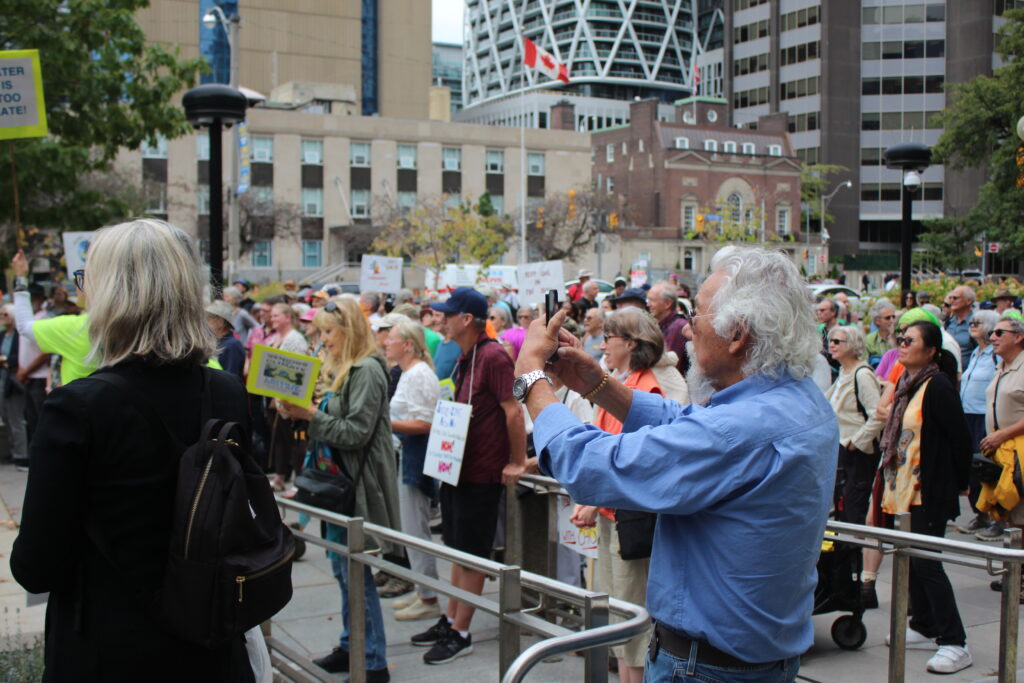
David Suzuki joins crowds of seniors watching youth climate activists speak at the start of the rally. (OTR/Kiera Osborne)
More than 400 people gathered in Toronto for the Seniors for Climate event on National Seniors Day, united in their support of climate action. The Toronto gathering was one of 75 concurrent events held across Canada according to the Seniors for Climate website.
They began with a march from the intersection of University Avenue and Armoury Street to the Church of the Holy Trinity, where well-known speakers David Phillips and David Suzuki spoke alongside youth climate activist Amy Mann.
“I think as you get older, you start thinking about your children and your grandchildren, what’s the world going to be like when you’re no longer here?” asked Sharon Zeiler, member of Climate Action for Lifelong Learners (CALL) and spokesperson for the Toronto Seniors for Climate event, in an interview leading up to the event.
The event featured collaborations between senior activism groups CALL, the Suzuki Elders, Grandmothers Act to Save the Planet, Climate Legacy, For Our Grandchildren and Seniors for Climate Action Now.
Zeiler explained that many members of CALL and similar organizations are retired and have time, funds, and voting power that many youth activists lack.
“Politicians often will listen to seniors simply because, of course, they want our vote,” she said in the interview.
Seniors at the event talked about their actions supporting the climate activism of the youth – but for younger attendants like Jillian Lefebvre, a student at George Brown College, they also serve as an inspiration.
She said that her grandmother (who is Indigenous) instilled in her a passion for the environment. “My parents, my grandparents, we’re all very passionate and we work together,” she said.
At the start of the rally, young climate activists spoke while David Suzuki watched, proudly pulling out his phone to take pictures.
“I’m delighted to have the youth here so strongly, and contributing,” he later said to the crowd gathered at the church.
“But I tell you, I feel humiliated that young people have to show the kind of leadership they are now,” Suzuki said. “That’s our job, to look out for their future.”
In June 2024, UN Secretary-General Antonio Guterres called advertising and PR agencies “enablers to planetary destruction” due to their work for fossil fuel clients.
2024 has been the hottest year on record, but the fossil fuel industry has “sought to delay climate action — with lobbying, legal threats, and massive ad campaigns. They have been aided and abetted by advertising and PR companies – Mad Men…fuelling the madness.”
Many things in the advertising industry have changed since the 1960s, but when it comes to climate change, major holding companies are still stuck in the era of indoor smoking, three martini lunches, and Don Draper.
Annual investment in clean energy is now double that of fossil fuels. More electric cars were sold in the first quarter of 2024 than in all of 2020. Economic damage from climate change will cost the average US consumer $500,000 in their lifetime.
But the agencies working with fossil fuel clients remain stuck in the Mad Men era, ignoring the impact of their work for polluters, and its consequences for their reputation and talent.
The 2024 F-List shares 1010 fossil fuel contracts held by 590 ad and PR agencies in 2023-2024.
Like every other outdated practice of the ad industry, it’s only a matter of time before fossil fuel campaigns come to an end. Mad Men no longer rule Madison Avenue, and climate madness must end. Clean agencies who reject fossil fuel clients are the future.




 My Climate Change Website